Introduction
Basic Chrome Sulphate (BCS) serves as a critical input in leather processing, forming stable chrome-protein complexes that enhance tensile strength and flexibility. Its application spans automotive upholstery, footwear, and fashion goods. Global demand mirrors the $400 billion leather market, with BCS consumption driven by over 3.5 billion square feet of annual leather output, predominantly in Asia-Pacific. Stability in raw materials, regulatory compliance, and cost predictability remain essential, as chromium supply disruptions can raise wet-blue leather prices by $0.20–0.50 per square foot.
The BCS market reached approximately $0.62–1.2 billion in 2025, growing at a 4–5% CAGR. Automotive leather alone is projected to hit $54.6 billion by 2028, while producers navigate challenges from chromite ore scarcity and environmental regulations. Asia-Pacific retains 55–60% market share, emphasizing the importance of resilient supply chains and trusted partners like leatherchemicalsasia for sustainable and reliable sourcing.
Global Supply Chain Overview
Major BCS producers include Lanxess (Germany), SISECAM (Turkey), Yinhe Chem (China), Brother Tech, Aktyuninsk (Kazakhstan), and Vishnu Chem (India). China leads with 45% of global output at over 300,000 MT annually, followed by India (20%) and South Africa (15%). These countries leverage abundant chromite reserves, with global chromium production reaching 35 million metric tons in 2023, primarily from South Africa and Kazakhstan.
Key importing regions include Asia-Pacific (50% share), Europe (25%), and Latin America (15%), with the U.S. and Middle East making up the balance. EU anti-dumping duties on Chinese BCS since 2023 have redirected 10–15% of volumes to Southeast Asia, tightening supply in other regions. Market dynamics hinge on chromite ore pricing, energy costs, and geopolitical factors, with FOB prices fluctuating from $1,200/MT in 2023 to $1,800/MT in 2025 due to Red Sea disruptions and inflation. Leather tanning chemicals, where BCS represents 46.8% of revenue, are projected to grow from $11.6 billion in 2025 to $36.9 billion by 2035 at a 12.3% CAGR.
Common Supply Chain Challenges
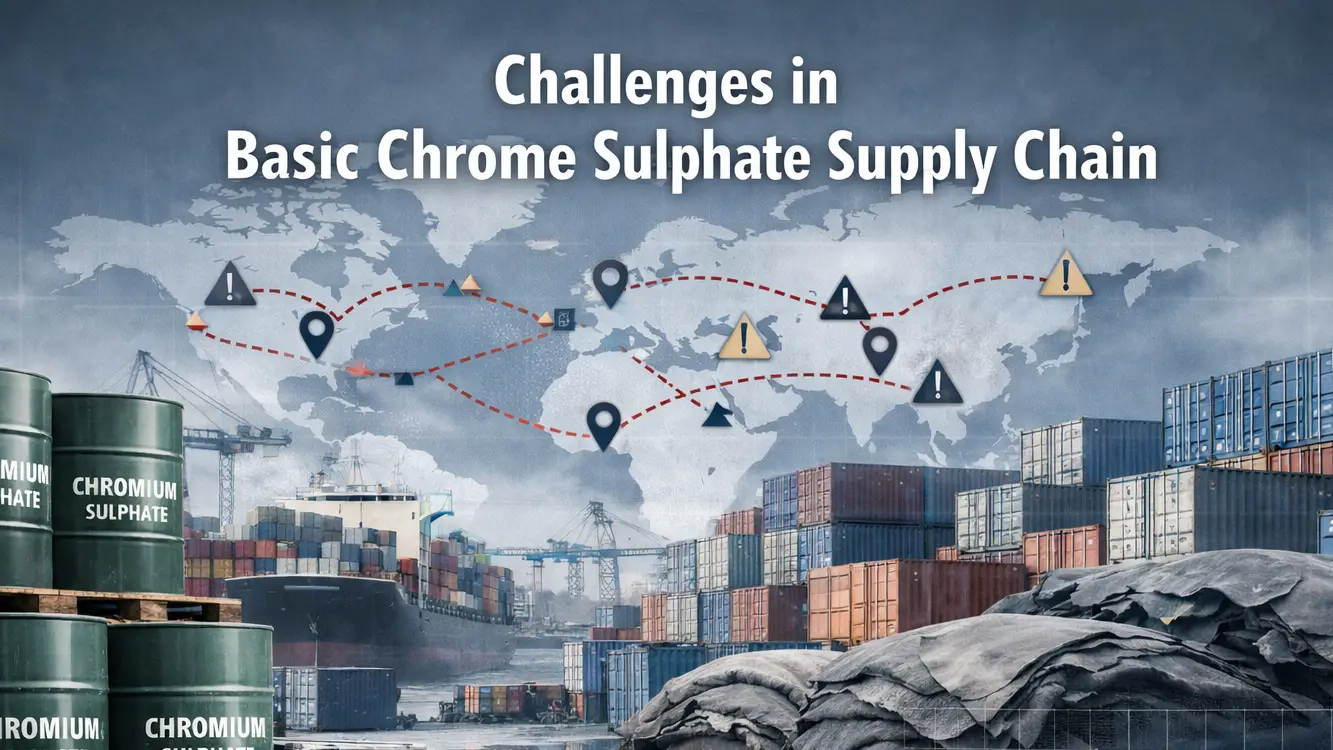
Raw material availability is sensitive to mining conditions. South Africa’s 8% output drop in 2024 caused global BCS shortages. Ore dependency exposes the industry to strikes and export quotas, while China’s chromium restrictions increased scarcity by 10–12%. Price volatility, rising 30–50% in 2025, coupled with freight costs of $4,000–6,000/TEU from Asia to Europe, erodes tanner margins since BCS constitutes 5–10% of wet-blue processing costs.
Transportation bottlenecks, including 20% delays post-2024, stem from port congestion in India and Vietnam. Regulatory hurdles such as EU REACH, China’s quotas, and India’s GST add 5–10% to compliance burdens. Environmental handling risks affect 40% of the market potential, emphasizing the need for sustainable sourcing and processing solutions.
Regional Supply Chain Insights
Asia-Pacific dominates with 55–60% BCS share, led by China and India. However, water scarcity limits chrome recycling, and bans in Tamil Nadu in 2024 increased import reliance by 12%. Vietnam and Pakistan experience monsoon-disrupted logistics, adding 15–20 days to lead times.
Europe and North America (20–25% share) prioritize REACH and CSLPA compliance, limiting local output and causing 25% peak-season stockouts. High energy costs and anti-dumping tariffs raise landed costs 20–30%.
Emerging markets, including Latin America and Africa, face infrastructure gaps and currency controls, extending delays by 30–40%. Brazil’s leather exports remain vulnerable to ore import volatility, while political instability and eco-regulations encourage a 35% shift toward sustainable alternatives.
Impact on Leather Industry
BCS shortages can halt production by 10–15%, driving up wet-blue costs and squeezing margins, particularly in Vietnam, which accounts for 40% of global leather exports. Automotive and footwear sectors experience 5–8% rejects from BCS failing ISO 4045 standards. Quality inconsistencies reduce hide yield by 3–5% and compromise durability. The industry increasingly adopts low-chrome BCS to meet sustainability demands and maintain performance.
Strategies to Mitigate Supply Chain Risks
Supplier diversification across China, India, and Kazakhstan stabilizes quality and mitigates outages. Inventory management using AI forecasting tools, such as SAP IBP, creates 60–90 day buffers, reducing stockouts by 25%. Blockchain traceability and automated logistics cut delays 15–20%, while chrome recovery technologies achieve 95% efficiency, aligning with green mandates. Leveraging partnerships with reliable suppliers like leatherchemicalsasia ensures consistent product quality, regulatory compliance, and operational efficiency without disrupting production cycles.
Future Outlook
BCS demand may slow 5–7% annually through 2030 due to chrome recycling and bio-tanning alternatives, yet the market is expected to grow from $0.62 billion in 2025 to $0.87 billion by 2035 at a 3.2% CAGR. Asia-Pacific continues to drive growth through India’s $2 billion tanning parks, targeting $1.2–1.8 billion BCS value by 2033. Opportunities lie in low-chromium BCS, nearshoring under trade agreements like USMCA, and eco-innovations triggered by the EU Carbon Border Adjustment, expected to expand green solutions by 35%.
Conclusion
BCS supply chains face ore volatility, logistical bottlenecks, and regulatory pressures, directly affecting leather production efficiency and costs. Strategic supplier diversification, digital tools, and investment in sustainable chrome technologies can reduce risks by 30%, while maintaining leather quality and accessing premium eco-conscious markets.
Leave a Comment