Introduction
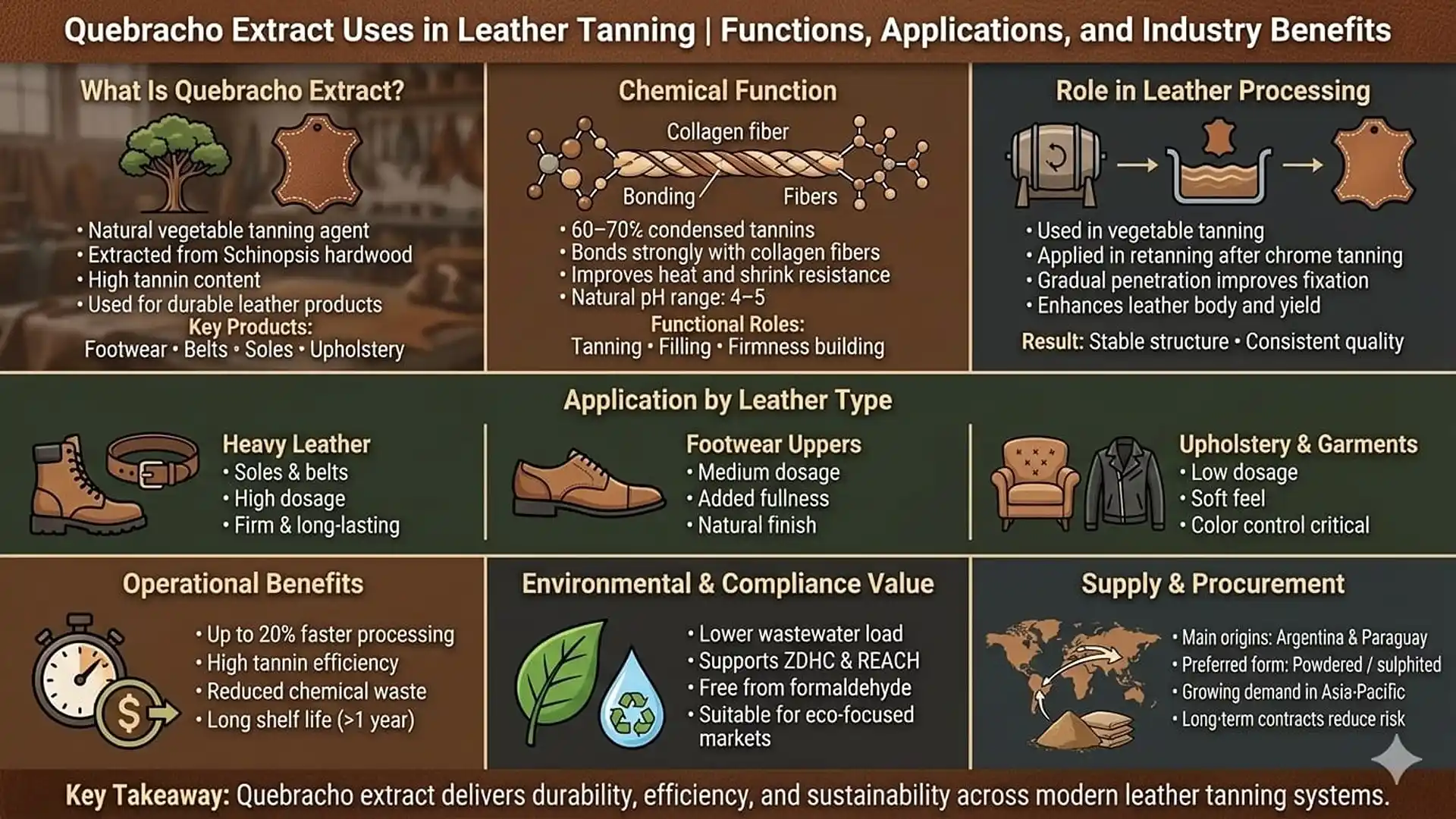
Quebracho extract is a widely used vegetable tanning agent in the leather industry. It is valued for its high content of natural tannins, which are extracted from the heartwood of Schinopsis trees. Tanneries use quebracho to produce firm, durable leather for products such as footwear uppers, belts, soles, and upholstery. Its natural origin, stable performance, and strong tanning effect make it a trusted material for both traditional and modern leather processing.
This article explains how quebracho extract works, where it fits in leather production, how usage differs across leather types, and what value it brings to operations.
Chemical Composition and Functions
Quebracho extract contains around 60–70% condensed tannins. These tannins are mainly high-molecular polyphenols that bond strongly with collagen fibers in animal hides. Through this bonding action, quebracho stabilizes the hide structure and improves resistance to heat and shrinkage.
The extract has a mild natural acidity, usually around pH 4 to 5. This allows tanning to take place without heavy pH correction. In practice, quebracho works as a tanning agent, a filling material, and a firmness builder. It helps plump loose fiber areas, improves leather compactness, and increases tear strength, especially in heavy leathers.
Compared with synthetic tanning agents, quebracho provides natural fixation. When used together with chrome tanning, it helps reduce chrome migration and improves overall leather stability. Because quebracho dissolves better in warm water, it is normally applied at temperatures above 35°C. This improves penetration and reduces chemical loss, making the process more efficient.
Role in Leather Processing Stages
Quebracho extract is mainly used during vegetable tanning and retanning stages. In full vegetable tanning, tanneries apply quebracho gradually through several liquor strengths. Weaker solutions penetrate the hide first, followed by stronger ones that fix the tannins inside the fiber structure. This process usually takes one to two days and produces the characteristic reddish-brown tone used for saddlery, belts, and sole leather.
In retanning, quebracho is added after chrome tanning or neutralization. At this stage, it fills empty fiber spaces created during liming and enzyme treatment. This improves leather body and yield, often increasing usable area by several percent. It is commonly blended with other vegetable extracts such as mimosa or chestnut to balance penetration and color.
After retanning, standard fatliquoring and setting steps follow. Quebracho helps maintain leather shape and size during drying and finishing, reducing deformation under mechanical stress.
Application Differences Across Leather Sectors
Usage levels of quebracho vary by leather type. Heavy leather sectors, such as sole and belting production, use higher amounts to achieve firmness, waterproofing, and long service life. These applications benefit most from quebracho’s strong tannin structure and filling ability.
Footwear upper leather uses lower dosages, mainly during retanning. Here, the goal is to add fullness and create a natural burnish effect without making the leather too stiff. Garment and upholstery leathers use even smaller amounts, as softness and color control are more important than firmness.
In automotive and furniture upholstery, quebracho is often chosen because it is free from formaldehyde and azo dyes. Its natural profile helps meet strict chemical safety standards. However, dosage must be controlled to avoid unwanted color tones, especially in light or neutral shades.
Operational Value in Production
Quebracho extract delivers strong operational benefits for tanneries. Its fast fixation in warm floats can shorten tanning or retanning cycles by up to 20%, allowing higher drum throughput. The extract is stable in storage and does not ferment easily, giving it a shelf life of more than one year when kept dry.
From a cost perspective, quebracho offers high tannin yield compared with other vegetable extracts. This reduces the total amount needed per hide and supports overall cost savings. Powdered or spray-dried forms also lower transport costs, which is important for Asia-Pacific importers dealing with variable freight rates.
Environmental performance is another advantage. Compared with pure chrome systems, quebracho-based or combination tanning produces lower organic load in wastewater. This helps tanneries meet environmental rules such as ZDHC and REACH while reducing treatment costs.
Supply Chain and Procurement Insights
Most quebracho extract comes from Argentina and Paraguay, where it is produced as a by-product of hardwood processing. The extract is standardized for tannin content and solubility to ensure consistent performance. Buyers often prefer sulphited grades because they dissolve more easily and provide better process control.
Asia-Pacific demand, especially from Indonesia and India, continues to grow as vegetable and combination tanning gain popularity. Procurement teams focus on quality consistency, color stability, and sustainable sourcing. Certified supply is becoming more important due to forest protection rules and buyer sustainability requirements.
Long-term contracts help stabilize pricing and secure supply, especially as environmental regulations tighten around raw material harvesting.
Conclusion
Quebracho extract remains a valuable and reliable tanning agent in the leather industry. Its high tannin content, natural fixation, and strong filling properties make it suitable for a wide range of leather products, from heavy soles to fine upholstery. Beyond performance, it offers clear benefits in cost control, process efficiency, and environmental compliance.
As leather producers in Asia-Pacific continue to balance quality, sustainability, and regulatory pressure, quebracho extract is expected to remain an important part of vegetable and combination tanning systems. Tanneries that manage dosage carefully and source from certified suppliers can achieve consistent leather quality while supporting long-term operational stability.
Leave a Comment